


The collaborative research and exhibition project of the Kadriorg Art Museum / Art Museum of Estonia and the Sinebrychoff Art Museum / Finnish National Gallery focuses on paintings in each collection associated with the Antwerp painter Maerten de Vos (1532–1603) and his workshop. Based on the nature of these works, De Vos’s workshop practice, working methods, and the spread and appreciation of his art receive special attention.
The Wedding at Cana (1597), associated with Maerten the Vos, is one of the most imposing works of the permanent exhibition of the art of the Low Countries in the Kadriorg Art Museum. The aspects of genealogy, provenance and conservation history of the painting require more attention. The altarpiece Wedding at Cana (1596–1597) in the Antwerp Cathedral, painted by de Vos for the Antwerp wine merchants’ guild, is one of the most outstanding works from De Vos’ late career.
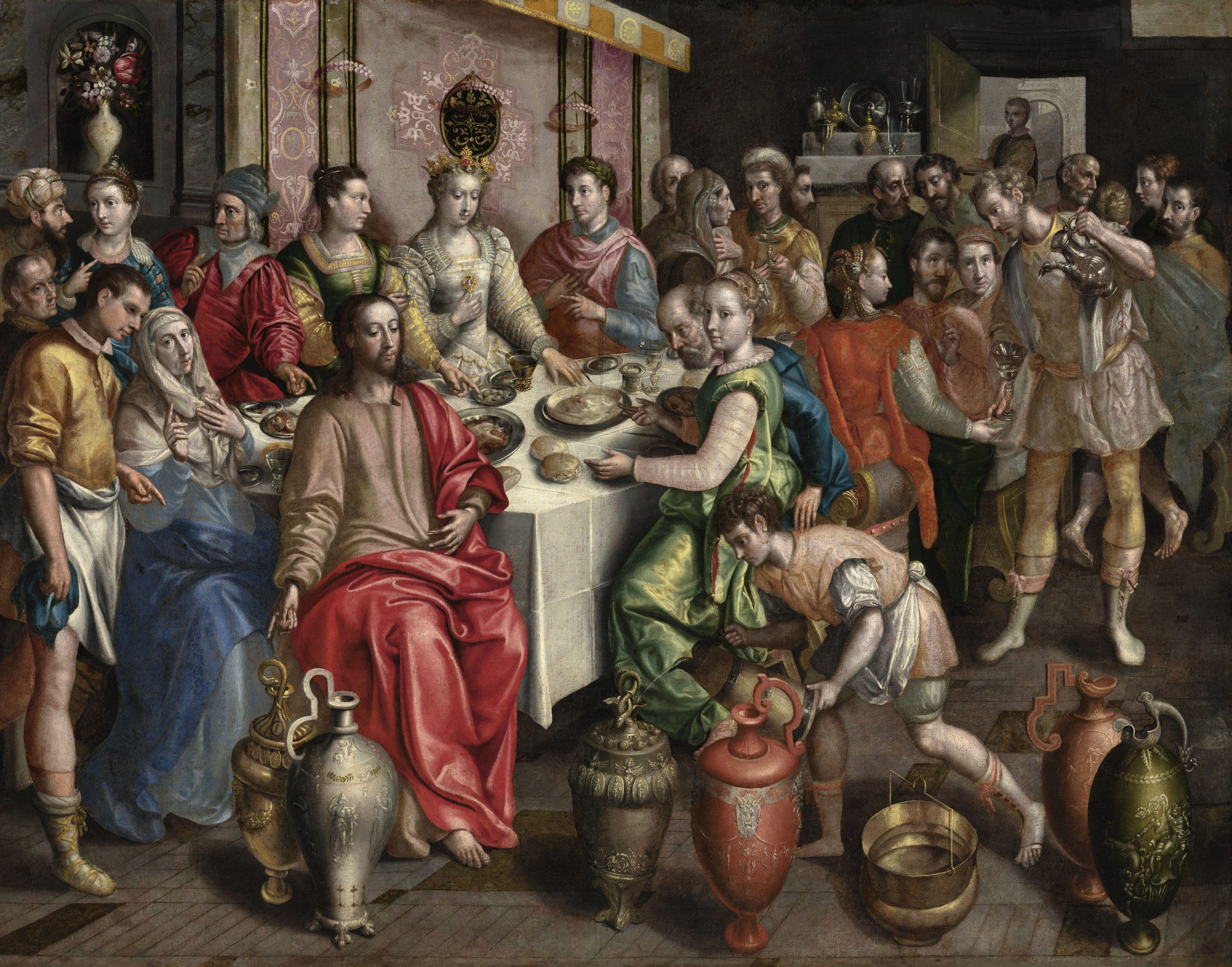
Unlike the original, which is a panel painting, the Tallinn version is painted on canvas, and its format is horizontal, instead of vertical.
Where and when was the Tallinn painting completed? Was it painted in de Vos’s workshop? What functions has the painting served in its history? What does the different choice of support materials and working methods tell us? How did the painting end up in Estonia? These are just some of the questions that remain unanswered.
The Crucifixion (A II 1261) in the Sinebrychoff Art Museum shows the same composition as the central panel of the altarpiece Maerten de Vos painted for the chapel in the Castle of Celle in northern Germany in 1569. Similar to the painting in Tallinn, questions regarding Maerten de Vos’s workshop arise.
During its history, the Sinebrychoff panel had been subject to many changes and was thus in very poor condition. A thorough conservation treatment was carried out in 2000–2002. The condition of the artwork was stabilised, but many questions remained unanswered then, notably related to the history and the attribution of the painting. A comparative analysis of the painting technique with confirmed works by Maerten de Vos, which will be carried out in the course of the following research, will help clarify the attribution of the painting in Helsinki.
Focus
One of the main focuses of this collaborative research project is to gather more information through a multifaceted study in order to better situate the two works in connection with de Vos and to get a better idea of de Vos’s creative and workshop practices. The broader aim of the project is to promote Maerten de Vos as an exceptionally inventive and influential artist of his time, whose oeuvre requires more thorough rediscovery and research. His works were internationally in high demand during his lifetime and, through the medium of printmaking, were able to circulate widely via Catholic, Lutheran and Orthodox art, spreading across Europe and to Christian lands overseas. De Vos’s artistic practices coincided with a politically complex period, which required constant adaptation to new circumstances and fluency in art diplomacy. His oeuvre, deeply engaged with historical narratives and earlier artistic traditions, which modernist art history deemed to be eclectic, revealed his humanist world-view and erudition.
The joint exhibition of the Kadriorg Art Museum and the Sinebrychoff Art Museum displays a versatile overview of Maerten de Vos’s creative output, showcasing paintings, prints and drawings; a special focus is on the topic of the spread and adaptation of Maerten de Vos’s art.
De Vos provided visual imagery for a very wide range of topics: he created religious scenes in monumental formats and provided designs for around 1600 prints; in addition, he depicted people and animals and recorded historical events. The exhibition includes a number of international loans from museums in Belgium and Germany.
The preparation process for the exhibition will be carried out with close communication with Belgian art institutions (the Royal Museum of Fine Arts Antwerp (KMSKA), Museum Plantin-Moretus, Rubenianum and Royal Institute for Cultural Heritage (KIK-IRPA)) and internationally recognised experts in their fields.
The year 2032 marks the 500th anniversary of Maerten de Vos’s birth. Therefore, several exhibitions are planned for the artist’s hometown of Antwerp to honour de Vos and his legacy.
The exhibitions in the Kadriorg Art Museum and Sinebrychoff Art Museum are conceptually independent but complementary to the larger research on Maerten de Vos.
Exhibitions
Kadriorg Art Museum: September 2029 – January 2030;
Sinebrychoff Art Museum
The exhibition will be accompanied by a bilingual research catalogue (in Estonian and English)
Project team
Curators: Claudia de Brün (Sinebrychoff Art Museum) and Dr Greta Koppel (Kadriorg Art Museum, Art Museum of Estonia)
Conservators: Mihhail Staško (Estonian Art Museum) and Dr Ari Tanhuanpää (Finnish National Gallery)
Project Coordinator: Elo Agnes Kõiv (Kadriorg Art Museum, Art Museum of Estonia)
Advisory board:
Dr Nico van Hout, Head of Collection Research and the curator of 17th Century paintings, Royal Museum of Fine Arts Antwerp (KMSKA)
Dr Natasja Peeters, Director of Collections, War Heritage Institute in Brussels, Belgium
Prof. Erma Hermens, Director of the Hamilton Kerr Institute and Deputy Director of the Conservation and Heritage Science, Fitzwilliam Museum
Virgine D’haene, Curator of Old Master prints and drawings, Museum Plantin-Moretus, Antwerp
In collaboration with:
Exhibition project partners: Sinebrychoff Art Museum, Finnish National Gallery (Helsinki)